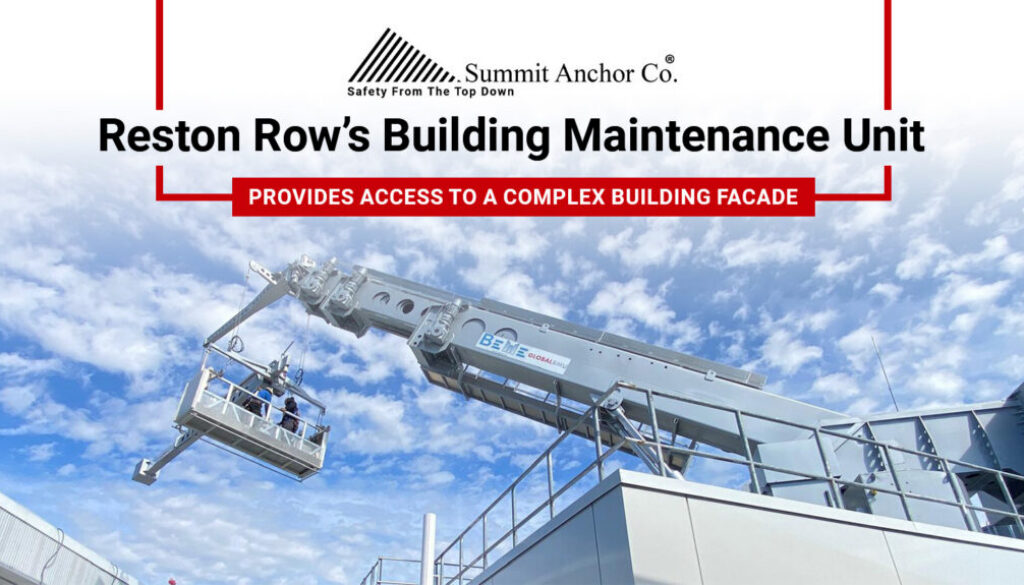
Reston Row’s Building Maintenance Unit Provides Access to a Complex Building Façade
By Gus Strats – Summit Anchor Company, Inc. August 3rd, 2026
Summit Anchor's BMU operations video
Planning for the Building’s Long-Term Access Needs
The windows on many buildings in the United States are maintained using rope descent systems. For façades with straightforward geometry and appropriate rigging locations, these systems can provide an efficient and practical access method.
However, a rope descent system is not the best solution for every building. Height, setbacks, projections, recessed areas, sloped façades and other architectural features can make portions of a building difficult—or impractical—to access with ropes alone. Owners and architects should evaluate these conditions early so the building’s long-term inspection, cleaning, maintenance and repair needs can be incorporated into its design.
Reston Row demonstrates how a custom-engineered Building Maintenance Unit, tailored to the building’s unique architecture and long-term maintenance needs, can provide a comprehensive solution for a complex façade.
Planning for the Building’s Long-Term Access Needs
Unlike a standardized access system, a Building Maintenance Unit (BMU) is individually designed around the architecture and operating requirements of a particular building. Its purpose is to provide safe and efficient access to exterior façades—and, in some applications, interior areas such as atriums—for window cleaning, inspection, maintenance, glazing replacement and repair.
A properly planned BMU can help an owner:
- Provide access to difficult façade areas
- Reduce repetitive rigging and equipment relocation
- Support routine window cleaning and inspection
- Facilitate glazing replacement and façade repairs
- Improve the efficiency of recurring maintenance operations
- Reduce the need for temporary access equipment
- Preserve the architect’s design while addressing long-term maintainability
At Reston Row, the building’s height, setbacks, projections and varying elevations made a custom-engineered powered access system a practical and comprehensive choice.
Extensive Reach from a Coordinated Rooftop System
As shown in the Reston Row animation, the BMU can be deployed from its stored position and configured to reach various portions of the building exterior. Its principal components include a base frame, machinery housing, mast, counterweight, hydraulic cylinder, telescopic jib, turning head, telescopic approach system, auxiliary hoist and suspended work platform.
The hydraulic cylinder raises and lowers—or “luffs”—the telescopic jib, while the rotating module allows the jib to turn around the mast. The jib can also extend and retract to vary the BMU’s horizontal reach.
The telescopic jib provides a maximum operating radius of approximately 82 feet, measured from the BMU’s center of rotation to the operating centerline of the suspended platform. As the jib rotates around the rooftop unit, this substantial reach creates a wide sweeping range across the building façade.
For the owner, this operating range means that multiple façade elevations, setbacks and projections can be reached from a coordinated rooftop system. Properly locating and configuring the BMU can expand access coverage while reducing the number of operating positions and relocations needed during the building’s maintenance cycle.
Reaching Beneath Projections and Into Recessed Areas
Horizontal reach alone does not ensure complete façade access. The platform must also be properly aligned with the façade and capable of reaching beneath projecting architectural features.
At the end of the Reston Row BMU’s telescopic jib, a turning head allows the suspended work platform to be rotated and positioned in line with the building façade. The telescopic approach system provides additional horizontal platform movement, allowing workers to reach beneath projecting building features and access recessed portions of the façade.
Together, the telescopic jib, turning head and telescopic approach system allow the platform to be positioned around multiple façade conditions. Once properly positioned, the platform can be raised or lowered along the building exterior by the BMU’s roof-level hoisting machinery.
These capabilities give owners and architects greater flexibility when addressing complex architecture without overlooking the practical requirements of future façade maintenance.
Stabilizing the Platform Along the Façade
An intermittent stabilization system is integrated into the Reston Row BMU and the building’s façade-access design. The system includes stabilization equipment associated with the suspended platform and strategically located intermittent stabilization anchors (ISAs) on the building façade.
As the platform travels vertically, workers connect the stabilization system at designated elevations in accordance with the manufacturer’s operating procedures. These connections help control horizontal platform movement caused by wind and other operational forces while keeping the platform properly positioned relative to the building.
For the owner, platform stabilization is an important part of maintaining safe and practical façade access. It helps protect workers, equipment and building finishes while improving platform stability during window cleaning, inspection and maintenance operations.
The location and spacing of the stabilization anchors must be coordinated with the building architecture, structural support and intended platform travel paths. Addressing these requirements early in design helps avoid gaps in coverage and ensures the stabilization system functions as an integral part of the complete BMU installation.
Supporting Glazing and Façade Repairs
The Reston Row BMU is also equipped with an auxiliary hoist that can lift approved materials, such as glazing, from the ground to the required work location.
This capability can support façade maintenance, glass replacement and repair activities without requiring the material to be carried inside the work platform. Delivering approved materials directly to the work area can reduce handling, save time and provide meaningful cost efficiencies over the building’s service life.
All lifting must be performed within the manufacturer’s rated capacities, operating instructions and project-specific limitations.
When Should an Owner Consider a BMU?
For new buildings exceeding 300 feet in height, powered access equipment should generally be among the first systems considered. OSHA restricts rope descent systems above 300 feet unless the employer demonstrates that another access method is infeasible or would create a greater hazard. Wind, rope management and stabilization also become increasingly difficult as descent height increases.
Height, however, is not the only consideration. A BMU may also be appropriate for lower buildings with:
- Large or complex façade areas
- Multiple setbacks or roof elevations
- Deep recesses or projecting architectural features
- Sloped or irregular façades
- Limited rope-rigging locations
- Significant recurring maintenance requirements
- Anticipated glazing-replacement needs
For buildings where vertical platform travel exceeds approximately 490 feet—or 150 meters—ASME A120.1 requires powered equipment with the hoisting machinery located at roof level.
The most appropriate access solution should therefore be selected by considering the building’s complete architecture, anticipated maintenance activities, frequency of use and long-term ownership objectives—not building height alone.
Early Planning Protects the Owner’s Investment
Façade access should be evaluated while the building design can still accommodate the necessary structural support, equipment operating areas, platform paths, stabilization anchors, storage provisions, electrical service and maintenance access.
Waiting until late in design or construction can create coverage limitations, architectural conflicts, structural revisions and added costs. Early collaboration among the owner, architect, structural engineer, façade consultant, BMU manufacturer and specialty access-system provider helps establish a practical system that supports both the architectural vision and the building’s long-term operational needs.
The Reston Row system illustrates the value of this integrated approach. Its rotating module, hydraulically luffed telescopic jib, turning head, telescopic approach system, auxiliary hoist and intermittent stabilization system work together to provide a coordinated solution for accessing and maintaining a complex building façade.
Summit Anchor Company works with owners, architects, consultants, contractors and equipment manufacturers to evaluate façade-access requirements and help coordinate BMU and fall-protection systems from early planning through installation, testing, commissioning and owner training.
Plan Your Next Façade-Access Project with Summit Anchor
Whether you are planning a new building or improving access on an existing property, call Summit Anchor Company early in the process. Our team can develop a practical plan for accessing and maintaining your building façade while helping identify potential challenges before they become costly limitations.
Depending on your project’s needs, Summit can provide façade-access consultation, project-specific animations, equipment layouts, drawings, specifications and system recommendations to help owners, architects and project teams understand how the proposed access system will function.
Call Summit Anchor Company for your next façade-access or BMU project, and let us help you develop a solution tailored to your building’s architecture, maintenance requirements and long-term ownership objectives.
The animation is a project-specific representation of the Reston Row BMU’s intended operating range and functionality. Actual operation must be limited to trained and authorized personnel working in accordance with the manufacturer’s instructions, rated capacities, required inspections, building-specific procedures and applicable safety standards.
CONTACT US.
Whether your project is in Athens, Greece or Anchorage, Alaska, or all points in between, we are your full service fall protection provider.
Call Summit Anchor Company today to speak with one of our representatives.